


Future of Cross-Regional Trade
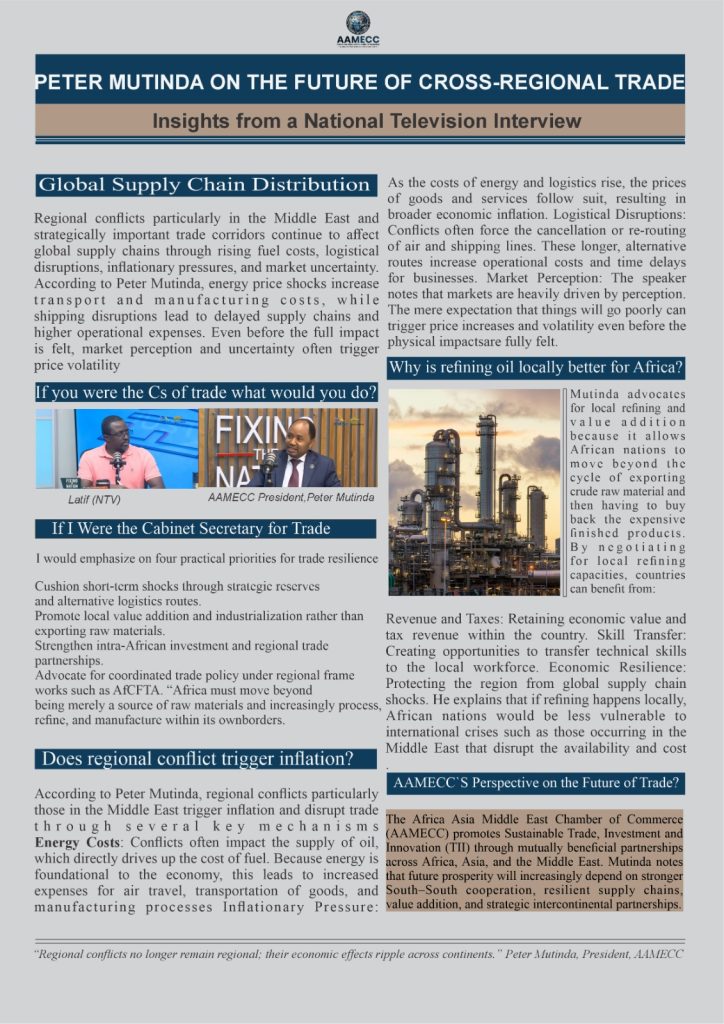
Future of Regional Trade Amid Regional Conflicts
This poster captures Peter Mutinda, President of AAMECC, during a national television interview with NTV’s Latif, addressing the future of cross-regional trade. His insights focus on driving intercontinental trade through resilience, local value addition, and strategic policy critical topics as global supply chains face mounting pressures.
How Regional Conflicts Trigger Inflation
Mutinda explains that regional conflicts, especially in the Middle East, disrupt trade through four key mechanisms: rising energy costs from oil supply shocks, increased transport and manufacturing expenses, rerouted shipping lines causing delays, and market perception—where uncertainty alone triggers price volatility before physical impacts are fully felt. These factors collectively drive inflationary pressures across economies.
If I Were the Cabinet Secretary for Trade
When asked what he would do as Kenya’s Cabinet Secretary for Trade, Mutinda outlines four practical priorities: cushion short-term shocks using strategic reserves and alternative logistics routes; promote local value addition over raw material exports; strengthen intra-African investment and regional trade partnerships; and advocate for coordinated trade policy under frameworks like AfCFTA. He states, “Africa must move beyond being merely a source of raw materials and increasingly process, refine, and manufacture within its own borders.”
Why Local Oil Refining Benefits Africa
Mutinda argues that local refining retains economic value and tax revenue, enables technical skill transfer to local workforces, and builds economic resilience against global supply chain shocks. If Africa refines its own oil, nations become less vulnerable to Middle Eastern crises that disrupt fuel availability and pricing.
AAMECC’s Vision for Future Trade
AAMECC promotes sustainable Trade, Investment, and Innovation (TII) through South–South cooperation. Mutinda concludes that future prosperity depends on resilient supply chains, value addition, and strategic intercontinental partnerships across Africa, Asia, and the Middle East Become a Member.
