

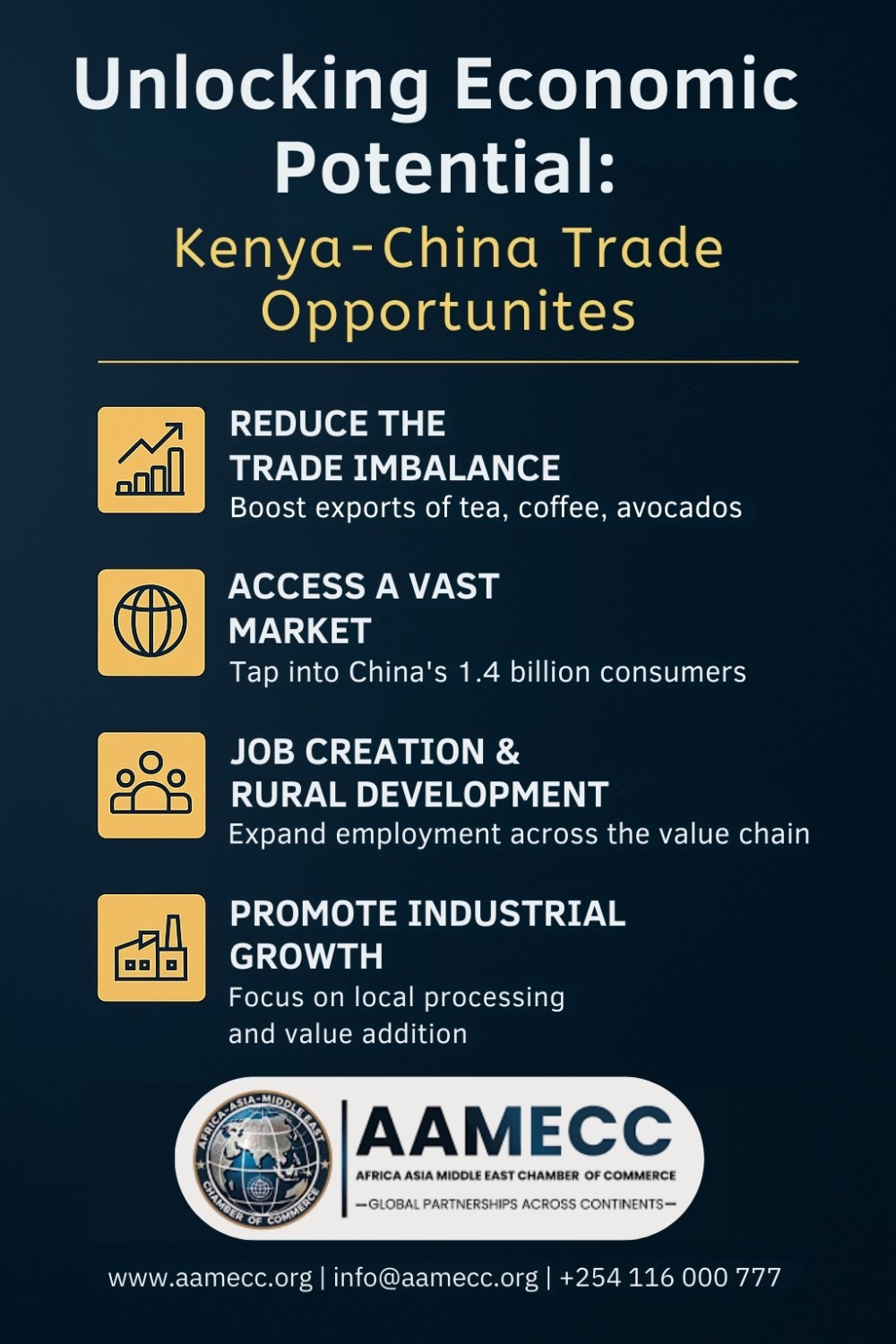
Unlocking Economic Potential: Kenya, China Trade Opportunities for Regional Growth
What if just 1% of China’s population bought Kenyan tea or coffee?
The impact could be transformative, revitalizing rural livelihoods, boosting export revenues, and reshaping regional trade dynamics.
From fertile fields to global markets, Kenya stands at the cusp of unprecedented trade opportunities with China. These opportunities have the potential to unlock new growth pathways for farmers, industries, and the broader East African region.
In this insight piece, Florah Muthaura, PPP Expert & Corporate Strategist, Head of Risk, Compliance & Sustainability at Kenya Mortgage Refinance Company (KMRC), and Board Director at the Africa Asia Middle East Chamber of Commerce (AAMECC), explores how strategic, economically focused engagement, free from political bias and centered purely on market potential, can catalyze export growth, job creation, and deeper regional integration.
Key Economic Benefits
Reducing the Trade Imbalance
In 2024, Kenya imported goods worth Kes. 576.14 billion from China, while exports stood at only Kes. 26.32 billion. By expanding exports of high-demand products such as tea, coffee, and avocados, especially through tariff exemptions, Kenya can narrow this trade gap, generate foreign exchange, and strengthen local production.
Access to a Vast Market
With a population of over 1.4 billion, China offers unparalleled market potential. Capturing even a small share of this market could significantly uplift farmer incomes, stimulate rural economies, and create long-term demand for Kenyan exports.
Job Creation and Rural Development
Growth in agricultural exports will catalyze employment across the value chain, from farming and processing to packaging, transport, and logistics. This ripple effect can generate thousands of jobs and enhance the resilience of rural communities.
Promote Industrial Growth and Value Addition
Local processing and packaging of export goods will enable Kenya to move up the value chain, increase profit margins, and align with national industrialization goals. This shift supports economic diversification and competitiveness.
Strengthening Regional Trade
A successful trade model with China can serve as a blueprint for similar agreements across East Africa, fostering a unified trade bloc with stronger bargaining power in global markets and promoting shared prosperity across the region.
The Role of AAMECC
- Facilitating Trade Partnerships – Connecting businesses to new markets.
- Building Export Capacity – Offering training on standards, packaging, branding, and market entry strategies.
- Policy Advocacy – Supporting streamlined trade policies and customs procedures.
- Promoting Investment & Value Addition – Encouraging joint ventures, technology transfer, and local processing.
- Market Intelligence & Research – Providing data-driven insights for better decision-making.
- Showcasing Success Stories – Highlighting impactful trade initiatives to inspire regional replication.
Conclusion
With strategic planning, investment in export capabilities, and strong regional collaboration, Kenya can turn these trade opportunities into a lasting driver of economic growth.
AAMECC stands ready to help member nations navigate and maximize such agreements, fostering prosperity across Africa, Asia, and the Middle East.
AAMECC – Connecting Markets. Creating Opportunities.
Which Kenyan product do you think has the biggest potential in the Chinese market?
Learn more about AAMECC at www.aamecc.org
